
781 words, 4 minutes read time.
There’s a new wave in 3D printing, and it’s led by Firestorm Labs. This American defense-tech startup is reshaping how modern militaries and emergency responders think about logistics, manufacturing, and drone deployment. Their solution? Deployable, containerized factories equipped with advanced 3D printing technology—designed to manufacture unmanned aerial vehicles (UAVs) directly in the field.
Firestorm Labs recently secured $47 million in Series A funding, supported by major investors and strategic partners, including the U.S. Department of Defense. With an additional $100 million IDIQ contract from the U.S. Air Force, Firestorm is scaling fast to meet critical operational needs across defense and humanitarian applications.
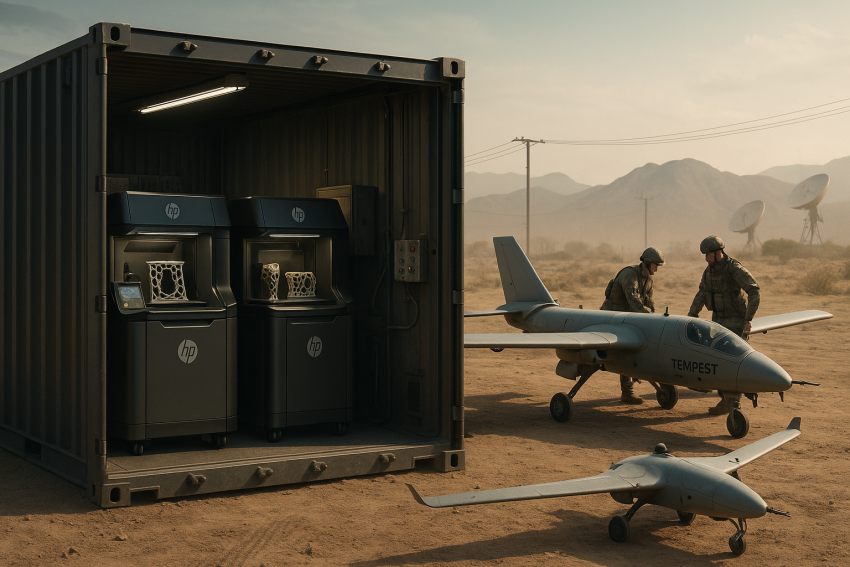
At the center of their innovation is the xCell: a modular, mobile factory outfitted with HP’s Multi Jet Fusion (MJF) 3D printing systems. These units are built inside ruggedized containers and can be rapidly deployed to challenging environments. Once on-site, they enable teams to print mission-critical components with speed and precision.
The xCell’s design reflects Firestorm’s commitment to practical, real-world functionality. It’s powered via onboard generators or external sources, networked for remote file transfer, and engineered to operate in extreme climates. This makes it suitable for deployment not only in conflict zones but also in disaster-stricken areas or remote expeditionary missions.
One of the company’s standout creations is the Tempest UAV—a modular drone platform built using MJF 3D printed parts. Its design supports quick adaptation to different missions, including reconnaissance, payload delivery, and more. Thanks to additive manufacturing, these drones can be customized, repaired, or rebuilt on-demand, eliminating long wait times for replacement parts and upgrades.
Firestorm’s collaboration with HP is also a major milestone for the additive manufacturing industry. They’re the exclusive deployer of HP’s MJF technology in expeditionary applications, underscoring the trust placed in their capabilities. The result is a production system that meets military-grade performance standards while leveraging the flexibility of modern 3D printing.
Crucially, Firestorm’s technology isn’t confined to theory or lab environments—it’s being tested and implemented today. With increasing global interest in portable manufacturing for defense and humanitarian missions, the xCell is attracting attention from allies and government agencies worldwide.
Beyond military use, the potential for Firestorm’s platform extends into areas like disaster relief, research stations, and remote industry. By enabling the rapid production of tools, spare parts, and customized equipment, their technology helps reduce reliance on complex, delay-prone supply chains.
What sets Firestorm apart is their focus on reliability. Every part produced undergoes thorough validation, including environmental stress testing and real-world flight trials. Their systems are designed to work under pressure—and they do.
From a technical standpoint, Firestorm’s embrace of MJF printing allows for high-strength, lightweight components with geometries that would be difficult or impossible to produce using traditional manufacturing. Their agile design pipeline also supports rapid iteration, improving performance and reducing turnaround time between concept and deployment.
Looking ahead, Firestorm is focused on scaling operations, expanding their product line, and exploring partnerships beyond defense. Their work represents a forward-thinking model of what additive manufacturing can become when applied with precision, vision, and purpose.
For 3D printing professionals and enthusiasts alike, Firestorm Labs is a compelling case study in taking additive manufacturing from the desktop to the frontlines. They’re demonstrating that with the right tools and mission-driven innovation, 3D printing can directly address some of the most urgent challenges in the world today.
If you want to stay on the cutting edge of additive manufacturing, defense tech, or field-deployable fabrication, keep your eyes on Firestorm Labs. Their work signals a powerful evolution in how—and where—advanced manufacturing happens.
Subscribe to our newsletter for more stories like this, and join the conversation with makers, engineers, and innovators who are redefining what’s possible with 3D printing.

Sources
- Exclusive: Drone‑printer Firestorm eyes expansion after $47 million round – Axios
- Firestorm and HP Join Forces to Transform Expeditionary Manufacturing – LaunchFirestorm
- HP and Firestorm Labs Use MJF in Deployable Factories – 3DPrint.com
- 3D-Printed Drone Accelerator Firestorm Labs Lands $47M – Stratified
- Firestorm Eyes Manufacturing with $47M Series A – Tectonic Defense
- USAF Invests $100M in Firestorm Labs for 3D‑Printed UAS – 3D Printing Industry
- Firestorm Secures $47M to Expand Mobile Drone Factory – WorldMilitaryFans
- US Aids Portable Drone Factories for Ukraine – Interesting Engineering
- Deployable 3D Printing in the Battlefield – VoxelMatters
- Firestorm Labs & DoD’s Shift to Software-First Manufacturing – Defense Tech Signals
- Inside Firestorm Labs Where Drones Are 3D Printed – Axios
- Firestorm Raises $47M to Scale Mobile Manufacturing – LaunchFirestorm
Disclaimer:
The views and opinions expressed in this post are solely those of the author. The information provided is based on personal research, experience, and understanding of the subject matter at the time of writing. Readers should consult relevant experts or authorities for specific guidance related to their unique situations.