
1,188 words, 6 minutes read time.
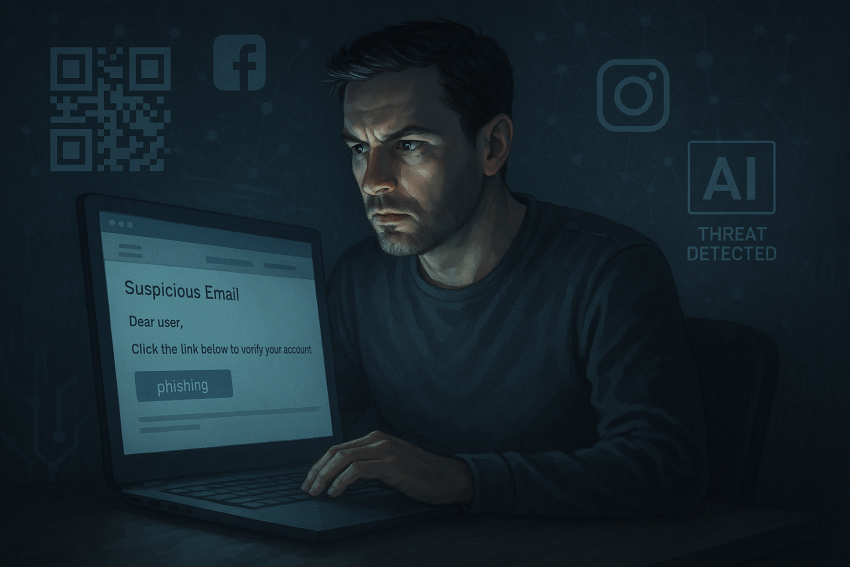
Welcome to the wild new world of phishing—where your inbox isn’t just annoying, it’s an active battlefield. Hackers aren’t just sending Nigerian prince emails anymore. They’ve leveled up. We’re talking AI-crafted emails that sound eerily human, browser-based attacks that slither past your antivirus like a ninja in socks, and tactics so clever they’d make a magician jealous.
If you’re the kind of guy who double-checks the torque on his lug nuts or doesn’t skip leg day, you should be just as serious about how you handle your digital hygiene. Let’s crack into what’s going on behind the screen, why it matters, and how to stay one step ahead of the phishing game in 2025.
Smarter, Meaner, and Way More Believable
Phishing in 2025 isn’t the same clumsy operation it was a decade ago. Hackers now use AI to write emails that mimic corporate lingo, personal speech patterns, and even your boss’s writing style. Tools like FraudGPT and WormGPT—yep, evil twins of ChatGPT—have become weapons of mass deception.
Think about it like this: imagine your buddy texts you something that sounds like him, asks for something small—but it’s not him. That’s the vibe. These AI phishing kits don’t just toss in a link anymore; they craft believable narratives, complete with proper grammar, personalized references, and perfect timing.
A classic example? An AI-generated email from your company’s “IT department” during a known software update window. It links you to what looks like an internal login page. One click later, your credentials are toast—and they didn’t even have to try that hard.
The Tools of the Trade Have Evolved
Attackers today are packing more than just sketchy email addresses and bad spelling. They’ve embraced tools like QR codes—ever heard of quishing? That’s phishing via QR code. Picture this: a printed flyer at your gym says you’ve won a gift card. You scan it while catching your breath. Boom—you’re redirected to a login prompt that steals your credentials faster than you can say “protein shake.”
There’s also HTML smuggling. Sounds exotic, but it’s just a sneaky way hackers hide malware inside what looks like an innocent attachment. Even the latest security tools can choke on these cleverly obfuscated payloads.
They’re also using HEAT (Highly Evasive Adaptive Threats). These are browser-based attacks designed to slip past traditional endpoint protections. Ever browse a website and get redirected to a fake login page without realizing? That’s HEAT in action—slick, quick, and hard to detect.
Multiple Fronts: It’s Not Just Email Anymore
You used to only worry about shady emails. Now, phishing attacks are coming through SMS (smishing), social media DMs, fake job offers on LinkedIn, even calendar invites. Attackers have become masters of social engineering—using context and emotional manipulation to trigger snap decisions.
They’re playing on urgency, fear, and convenience. “Your account has been compromised. Click here to fix it.” Sound familiar? It should—it’s the digital equivalent of a stranger yelling that your car’s on fire just to steal your wallet while you’re distracted.
Data Doesn’t Lie: It’s Worse Than You Think
Over 3 billion phishing emails are fired off daily. The rise of generative AI has juiced up the attack frequency by more than 1,200% since 2023. Even cybersecurity pros are falling for them. Studies show a click-through rate hovering around 34%—which means if you and two buddies are checking email, odds are one of you takes the bait.
The financial fallout is brutal. Business Email Compromise (BEC) alone is racking up billions annually in losses. And it’s not just the big boys getting hit—small and mid-sized companies are juicy targets because they often lack dedicated security teams.
Evasion Tactics: Like Ghosts in the Machine
Hackers are using zero-font text, invisible characters, and CSS tricks to fool spam filters. Basically, they’re dressing up their messages in digital camouflage. And because these messages often look exactly like legitimate ones, many security tools can’t tell the difference.
Some are even gaming AI summarizers. You know that Gmail feature that gives you a quick TL;DR of long emails? Hackers are embedding malicious instructions just outside the summary range, so what you see looks harmless, but what’s below is anything but.
Fight Back: Here’s How to Stay Sharp
Alright, now that you know the playing field, let’s talk defense. First rule? Don’t trust anything—seriously. Your gut is your best firewall. If something feels off, pause. Hover over links. Inspect QR codes before you scan. If your bank texts you, don’t tap—go to the site manually.
Get MFA (Multi-Factor Authentication) running on everything you care about. Yes, it’s annoying. So is losing access to your email. Choose your battles.
Train like it’s your digital gym. Run phishing simulations. Many tools offer this now—even gamified ones to keep things interesting. Learn how to spot the red flags.
And keep your browser and OS updated. Those little update popups? They’re like vitamins for your digital immune system. Ignoring them is like lifting weights with a torn ACL.
Looking Ahead: Stay Ahead
Phishing isn’t going away. If anything, it’s going to keep mutating like a sci-fi virus. But just like you wouldn’t go on a mountain hike with flip-flops and no map, you shouldn’t be online without prepping your defenses.
AI is your enemy right now, but it’s also your ally. Security tools that use machine learning are getting better at spotting threats in real-time. Set them up. Learn them. Use them. It’s like having a spotter in the gym—you’re stronger together.
And most importantly, share what you learn. Teach your crew. Talk about it in your group chats. If you’re the guy who can explain phishing in plain English, you’re already ahead of 90% of the pack.
Final Thoughts: Don’t Be That Guy
Look, phishing in 2025 isn’t about falling for a goofy typo anymore. It’s sophisticated, personalized, and relentless. But you’re not helpless. Stay curious. Stay paranoid—in a healthy way. And when in doubt, verify everything.
We’re building a community that fights back. Want more insights like this? Subscribe to our newsletter, drop a comment with your questions or war stories, or hit me up directly. Let’s make cyberspace a little less sketchy—together.

Sources
- Hoxhunt 2025 Phishing Trends Report
- SoSafe 2025 Cybercrime Trends
- AAG IT Support – Latest Phishing Statistics (June 2025)
- AnubisNetworks – Phishing Trends to Watch in 2025
- CrowdStrike 2025 Global Threat Report
- Splunk – Top Cybersecurity Trends 2025
- KnowBe4 2025 Phishing Threat Trends Report
- Huntress 2025 Phishing Threat Report
- WEF Global Cybersecurity Outlook 2025
- Verizon 2025 Data Breach Investigations Report (DBIR)
- Spacelift – Phishing Attack Statistics & Trends 2025
- Weinz et al. “The Impact of Emerging Phishing Threats…” (arXiv, May 2025)
- Arun & Abosata “Next‑Gen Phishing Attacks Using AI Browsers” (arXiv, June 2024)
- Falade “ChatGPT, FraudGPT, WormGPT in Social Engineering Attacks” (arXiv, Oct 2023)
- Anti‑Phishing Working Group (APWG) – Global Data & Guidance
Disclaimer:
The views and opinions expressed in this post are solely those of the author. The information provided is based on personal research, experience, and understanding of the subject matter at the time of writing. Readers should consult relevant experts or authorities for specific guidance related to their unique situations.