
1,304 words, 7 minutes read time.
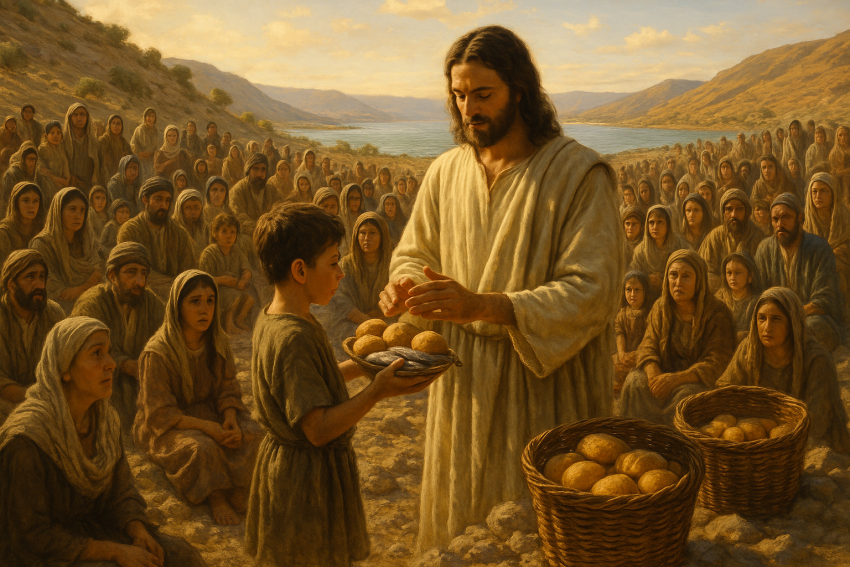
I was there. I saw it with my own eyes. And no, this isn’t some tale of miracles you hear tossed around on Sundays like candy from a pulpit. It’s raw, real, and it shaped me in ways I’m still trying to understand. My name is Eli, and I was one of those men in the crowd on that dry hillside by the Sea of Galilee when Jesus did the unthinkable—he fed five thousand souls with nothing but a boy’s meager lunch.
I’m not the kind of man who believed in miracles. In fact, I barely believed in God. I was ambitious—maybe too ambitious—and I thought power and knowledge were what ruled this world. I spent years chasing those things, often crossing lines I now regret. Back then, I justified every selfish move by telling myself the world was a ruthless place, and only the cunning survived. But that day, sitting among thousands, something shifted. I want to tell you why, but first, you have to understand where I was coming from.
The crowd was huge—men, women, and children packed like sardines on that dusty slope. They followed Jesus because he spoke differently, healed the sick, and offered hope when everything else was bleak. I followed out of curiosity, maybe a hint of desperation. My life was spiraling; my own ambition had led me into dark places, leaving me hollow and hungry—not just for food, but for meaning. The sun was relentless, and the murmurs among us grew louder as the day wore on. No one had eaten since dawn. You could see it on their faces—the impatience, the quiet frustration, the simmering doubt.
The disciples looked rattled. They came to Jesus with the problem—there’s no food, and these people are hungry. Their voices held an edge of panic, but Jesus seemed oddly calm. The irony wasn’t lost on me. Here we were, thousands of mouths to feed, and all anyone could find was a boy with five barley loaves and two small fish. It was laughable. I remember thinking, “What’s he going to do with that? Feed an army with a kid’s lunchbox?”
I was wrong.
The boy who offered his food didn’t ask for credit or reward. He simply gave what little he had. That’s a detail that stuck with me—the pure, uncalculated generosity of a child. I was no child. I was a man chasing power, willing to deceive and manipulate to climb higher. I justified it all, telling myself survival demanded it. But deep down, I knew that something essential was missing in me.
Then Jesus took the loaves and fish. He looked up, not at the crowd, but upward—as if drawing strength from somewhere beyond our understanding. He gave thanks quietly. It wasn’t a grand spectacle or a booming proclamation. Just a moment of genuine gratitude. I could feel something in the air shift. The tension that had coiled in my chest loosened slightly. There was a calmness in Him that I envied.
Hands began to pass the food around. One by one, people ate. I watched with disbelief as loaves multiplied, as fish kept appearing, feeding all five thousand plus women and children. There was no magic show, no flashy tricks. Just enough, then more than enough. I was stunned. How was this possible?
I tried to rationalize it. Maybe someone had secretly brought more food, and we hadn’t noticed. Maybe it was mass hysteria. But the look on the faces of those around me told a different story—they were fed. Real hunger satisfied.
I still struggled with what I saw. You have to understand: my ambition was my downfall. I was on a path of destruction, blinded by pride and greed. I thought knowledge and power were my destiny, yet that day I glimpsed something else—something beyond human control.
Then Jesus, in that quiet moment of blessing the loaves, changed everything for me. It was like a door cracked open in my mind. Maybe fate isn’t just the cold hand of destiny crushing us under its weight. Maybe free will means trusting in something bigger than ourselves—even when it doesn’t make sense. Even when it means giving away what little we have.
After the crowd ate their fill, twelve baskets of leftovers were collected—more than enough food left to feed others. Some of the men whispered doubts, calling it trickery or coincidence. Others looked at Jesus with newfound faith. I was caught somewhere between awe and skepticism. Could this man really be the Messiah? The one promised to Israel?
I thought about all the times I had deceived, manipulated, and betrayed. I told myself it was necessary, that the world rewards the ruthless. But watching that boy give his simple lunch, I felt exposed. My hunger was deeper than food. It was for acceptance, purpose, peace. Yet I had been chasing the wrong things.
The crowd dispersed slowly. Some followed Jesus from that day forward. Others, like me, were stuck in the shadows of our own choices, unsure if we could ever step into the light. I wrestled with doubt and pride. “I deserved better,” I told myself. “I earned my place by strength.” But the feeding of the five thousand had exposed the lie behind my ambition.
Looking back, I see the story as a powerful metaphor for our modern hunger—not just for bread, but for meaning. Jesus didn’t just feed bodies; he fed souls starved by a world that values power over grace. His miracle wasn’t just about multiplication of food; it was about multiplying hope where there was none.
For men like me, it’s tempting to believe we can control everything by knowledge and force. But that day on the hillside taught me faith is about surrender. Not weakness, but strength to trust beyond what we can see or prove.
If you’re here today hungry—maybe for success, approval, peace, or something you can’t name—know this: the God I met on that hillside still feeds the hungry. Maybe not in ways you expect, and maybe not always immediately. But He offers more than enough for those willing to receive it.
You don’t have to understand it all. You don’t have to have all the answers. You just have to be willing to sit with your hunger and see what happens when Jesus gives thanks and breaks the bread.
I’m still learning to let go of my pride and ambition. I’m still wrestling with the choices I made and the man I became. But one thing is clear: miracles aren’t just ancient stories. They are invitations to step beyond control and trust that provision comes in unexpected ways.
If you walk away hungry today, I hope you come back. Because I was there when He fed the five thousand, and I know He’s still feeding men like us—one broken, hungry soul at a time.

Sources
- John 6:1–15 – Bible Gateway
- BibleRef Commentary on John 6:1
- Enduring Word Commentary – John 6
- GotQuestions: What was the feeding of the 5,000?
- Overview Bible: Feeding of the 5,000
- Blue Letter Bible – John 6
- The Gospel Coalition: Jesus and the 5,000
- Bible Hub Commentary – John 6:10
- Desiring God: You Have the Words of Eternal Life
- Crosswalk: The Significance of the Feeding of the 5,000
- Sermon Central – Feeding the 5,000
- Zondervan Academic: Feeding of the 5,000
- Ligonier: Feeding the Five Thousand
- Bible Study Tools: Feeding the 5,000
- Precept Austin Commentary on John 6
Disclaimer:
The views and opinions expressed in this post are solely those of the author. The information provided is based on personal research, experience, and understanding of the subject matter at the time of writing. Readers should consult relevant experts or authorities for specific guidance related to their unique situations.