
5,787 words, 31 minutes read time.
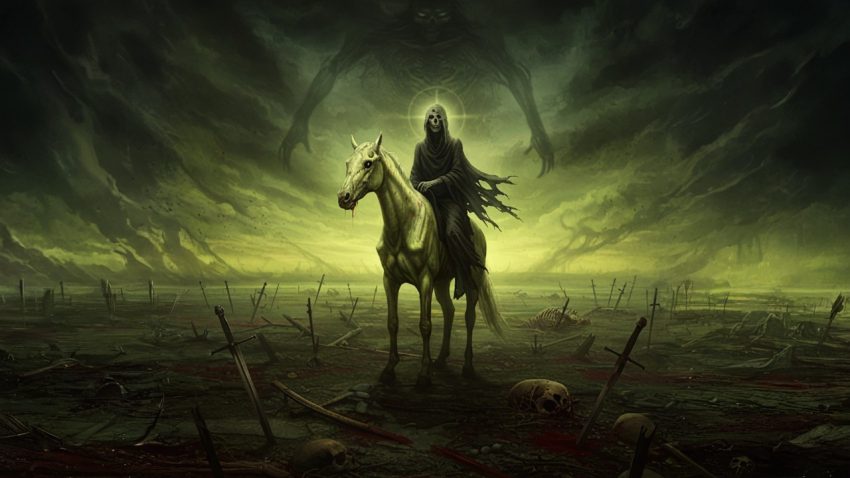
Image Source: The AI Pixel Prophet
The Fourth Seal – The Pale Horse of Death and Destruction
Our ongoing exploration into the Book of Revelation continues, a journey we embarked upon recognizing the profound weight and divine authority embedded within these prophetic visions. We initially established the critical understanding that this apocalyptic unveiling, while often shrouded in symbolic language, ultimately reveals God’s sovereign plan for judgment and redemption, a plan set in motion and revealed through the worthiness of the Lamb, Jesus Christ. We acknowledged the gravity of these revelations, understanding them not as mere historical curiosities but as vital insights for believers navigating the complexities of the present age and the unfolding of God’s ultimate purposes.
Our initial foray into the unsealed scroll brought us to the First Seal and the enigmatic rider on the white horse. We wrestled with the multifaceted interpretations of this opening act, considering whether it symbolized the initial victorious advance of the Gospel message or the subtle, deceptive rise of antichrist forces cloaked in an aura of power and seeming righteousness. This initial ambiguity served as a crucial reminder of the necessity for spiritual discernment and a careful examination of the forces at play in the world around us as we anticipate the unfolding of end-time events.
The breaking of the Second Seal plunged us into a starkly different and far more violent reality with the emergence of the fiery red horse. Here, the symbolism was less nuanced, depicting the brutal unleashing of widespread war, societal breakdown, and the tragic taking of peace from the earth. We explored the historical echoes of this devastating prophecy, from the early persecutions faced by Christians to the recurring cycles of conflict that have stained human history. The Second Seal served as a sobering acknowledgment of the destructive consequences of sin and the inherent fragility of human peace when divorced from God’s principles, all while affirming His ultimate sovereignty even amidst such global turmoil.
Now, as the Lamb continues to unveil His divine plan, we arrive at the Fourth Seal, a juncture that marks a significant and terrifying escalation in the unfolding judgments. Having witnessed the deceptive allure of the white horse, the bloody chaos of the red horse, and the crushing scarcity brought by the black horse of famine, we now confront a specter of even greater devastation: the arrival of the Pale Horse, bearing the very rider whose name is Death, with the realm of the dead, Hades, following closely behind. This is not merely a localized conflict or a regional famine; this is a divinely authorized unleashing of widespread mortality, wielding the combined forces of war, hunger, disease, and the very terrors of the natural world. As we delve into this grim vision, we will examine the chilling symbolism of the pale horse and its riders, explore its potential historical parallels, and grapple with the profound theological implications of such widespread destruction, paying close attention to the specific scope of its initial impact. Prepare yourselves to confront the ultimate earthly consequence in this unfolding apocalyptic drama.
Biblical Description of the Fourth Seal
Let’s turn our attention to the chilling pronouncement of Revelation 6:7-8: “When He opened the fourth seal, I heard the voice of the fourth living creature saying, ‘Come and see.’ So I looked, and behold, a pale horse. And the name of him who sat on it was Death, and Hades followed with him. And power was given to them over a fourth of the earth, to kill with sword, with hunger, with death, and by the beasts of the earth.” The imagery here shifts from the societal disruptions of war and famine to the stark reality of widespread mortality and the dominion of the grave. For a modern audience, some of these terms and their historical and cultural weight might require further illumination to fully grasp the terror this vision evokes.
First, we are confronted with a Pale Horse. The Greek word employed here, chlōros (χλωρός), carries a significance that extends beyond a simple lack of color. While “pale” is a common translation, its nuances point towards a sickly greenish-yellow or ashen hue. Think of the color of decaying flesh, the pallor of someone ravaged by disease, or the sickly tint of stagnant vegetation. This is not the vibrant white of potential victory, the fiery red of rage and conflict, or the somber black of mourning and scarcity. Instead, chlōros speaks directly to decay, disease, and the very visage of death. It’s a color that instinctively triggers a sense of unease and foreboding, a visual manifestation of mortality’s grip tightening on the world. This unsettling color immediately sets this horseman apart, signaling a new and terrifying phase of judgment.
Next, we encounter the Rider, and his identity is explicitly and unequivocally stated: Death. Unlike the more symbolic representations of the riders in the preceding seals, this figure is the personification of mortality itself. This isn’t merely about dying in battle or succumbing to hunger; this is the embodiment of the ultimate end that awaits all earthly life. This rider embodies the absolute and seemingly inescapable power of death’s dominion over humanity. He is the grim reaper in his purest form, the sovereign of the cessation of life. For a culture that often attempts to sanitize or distance itself from the realities of death, this stark personification serves as a brutal and unavoidable confrontation with our own mortality and the fragility of existence.
Following closely behind Death is Hades. For a contemporary audience less familiar with classical mythology and New Testament terminology, understanding Hades is crucial. In Greek mythology, Hades was the god of the underworld, the shadowy realm where the souls of the departed resided. However, in the New Testament, the term Hades (ᾅδης) often refers more generally to the realm of the dead, the intermediate place where souls go after physical death, awaiting the final resurrection and judgment. The fact that Hades follows with Death emphasizes the comprehensive and thorough nature of the destruction envisioned. It’s not just that life ceases on a massive scale, but that the realm of the dead swells to accommodate the vast number of those who perish. This paints a terrifying picture of widespread mortality leading to a correspondingly immense population in the afterlife, underscoring the sheer scale of the devastation brought by this seal.
Finally, the vision states that power was given to them over a fourth of the earth, to kill with sword, with hunger, with death, and by the beasts of the earth. Several key aspects of this statement warrant closer examination for a modern reader. Firstly, the phrase “power was given to them” is critical. It underscores that even this terrifying force of Death and the realm of the dead operate under the ultimate authority of God. Their actions are not random or outside of His sovereign control. This is a recurring theme throughout Revelation, reminding believers that even in the midst of immense suffering, God remains the ultimate orchestrator of history.
Secondly, the limitation “over a fourth of the earth” is a significant detail that distinguishes this judgment from the potentially more globally pervasive impacts implied in the earlier seals. While the devastation is undoubtedly immense, the specific fraction suggests that this is a significant but still partial judgment. It implies that while a vast number will perish, it is not a complete annihilation of all life on earth at this stage. This limitation provides a crucial point of comparison with subsequent judgments and highlights the progressive and intensifying nature of God’s unfolding plan.
Thirdly, the four instruments of death listed are comprehensive, representing multiple facets of destruction that would have been readily understood in both the first century and throughout history:
The sword directly echoes the Red Horse and symbolizes war, violent conflict, and military action. This is a form of death readily grasped by any generation familiar with the horrors of warfare.
Hunger directly links back to the Black Horse and represents famine, starvation, and the collapse of food supplies. This speaks to a fundamental human vulnerability and the desperation that arises from widespread lack of sustenance.
Death itself here, in addition to the personified rider, likely refers to pestilence, plague, and widespread disease. In a pre-modern world with limited understanding of disease transmission and often inadequate sanitation, plagues could decimate populations with terrifying speed. Even in our modern era, pandemics remind us of the potent destructive force of widespread illness.
By the beasts of the earth is a more nuanced element. It can symbolize several interconnected ideas. It could represent the breakdown of societal order, leading to increased danger from wild animals. It might also point to ecological disruption and imbalances in the natural world, where animals become a greater threat to human life. Some interpretations even suggest literal increases in animal attacks due to desperation in times of famine or societal chaos. Regardless of the precise interpretation, it signifies a further dimension of danger and mortality arising from the disruption of the natural order.
In essence, the Fourth Seal unveils a terrifying synergy of the destructive forces already hinted at in the preceding seals, now culminating in widespread death and the expansion of Hades’ domain over a significant portion of the earth, all under the ultimate authority of God. Understanding the historical and cultural context of the imagery is crucial for grasping the profound impact and sobering warning of this apocalyptic vision.
Symbolic Interpretations
The symbolism embedded within the Fourth Seal paints a truly grim and comprehensive picture of widespread annihilation, orchestrated by Death’s Four Instruments. The sword, a recurring motif from the Second Seal and its fiery red horse, continues to represent the brutal and indiscriminate ravages of war and violent conflict. This symbol speaks to the enduring and destructive nature of human aggression, where nation rises against nation, and the shedding of blood becomes a horrifyingly commonplace event. It reminds us that even as other forms of judgment unfold, the specter of armed conflict remains a potent force of death.
Hunger, the agonizing consequence of the famine brought forth by the Third Seal’s black horse, persists as another deadly weapon in the Pale Rider’s arsenal. This symbol transcends mere physical discomfort; it speaks to the slow, debilitating, and ultimately fatal process of starvation and the complete collapse of food supplies. When the fundamental need for sustenance is denied on a massive scale, societal order crumbles, desperation takes hold, and death becomes an inevitable outcome for countless individuals. The inclusion of hunger underscores the interconnectedness of the seals, showing how the consequences of one judgment often fuel the devastation of the next.
Adding to this terrifying duo is pestilence, or death itself, listed as a distinct instrument beyond the personified rider. This introduces the horrifying reality of widespread disease, plague, and pandemic outbreaks. In a world often grappling with emerging and re-emerging infectious diseases, this symbol carries a chilling contemporary relevance. Throughout history, plagues have swept across continents, decimating populations with terrifying speed and leaving unimaginable suffering in their wake. This instrument of death highlights the fragility of human health and the potential for microscopic enemies to unleash catastrophic mortality on a grand scale, irrespective of battlefields or economic status.
Finally, the Pale Rider is granted authority to kill by the beasts of the earth. This symbol is perhaps the most multifaceted and open to interpretation. On a literal level, it could signify an increase in attacks by wild animals due to ecological disruption, desperation caused by famine driving animals to prey on humans, or a breakdown of human control over the natural world. However, on a more symbolic level, “beasts” can also represent untamed chaos, societal breakdown leading to lawlessness and brutality, or even demonic forces unleashed upon the earth. It speaks to a primal level of danger, where the very foundations of safety and order are eroded, and humanity becomes vulnerable to forces both within and outside the realm of human control. Together, these four instruments – war, famine, disease, and primal chaos – paint a comprehensive picture of utter devastation targeting the very essence of human life and civilization.
The profound truth that this authority is divinely granted serves as a crucial anchor in the midst of such terrifying imagery. Death and Hades are not presented as rogue, autonomous forces operating outside the purview of God’s ultimate control. Their power, however immense it may seem, is limited and specifically given by Him, serving His ultimate, albeit often inscrutable, purposes. This reinforces the overarching theme of God’s sovereignty throughout Revelation, reminding believers that even in the darkest of times, He remains the ultimate authority, and nothing occurs outside the boundaries of His divine plan. This understanding, while not always providing easy comfort, offers a crucial theological framework for navigating periods of intense suffering and recognizing that even devastation serves a purpose within God’s grand design.
The significant connection to Ezekiel 14:21, where God outlines His “four sore judgments” against Jerusalem – “For thus says the Lord God: ‘How much more it shall be when I send My four sore judgments against Jerusalem—sword and famine and wild beasts and pestilence—to cut off man and beast from it!’” – provides a vital Old Testament parallel. This echo underscores that the judgments in Revelation are not arbitrary or unprecedented. Instead, they resonate with patterns of divine judgment seen throughout the history of God’s dealings with humanity, emphasizing the serious and far-reaching consequences of persistent sin and rebellion against His will. This link to Ezekiel grounds the apocalyptic vision in the established narrative of God’s justice and His response to human disobedience.
The specific detail regarding the authority granted to Death and Hades – power over a fourth of the earth – is a crucial point that warrants careful consideration. While the image of widespread destruction is undeniable, the numerical limitation suggests that this judgment, though catastrophic for a significant portion of the globe, is not yet total annihilation. This distinction from the earlier seals, which imply a potentially more pervasive impact of war and famine across the earth, highlights a progressive and intensifying unfolding of God’s judgments. Each broken seal reveals a further stage of tribulation, with the Fourth Seal marking a significant escalation in mortality but not the complete eradication of life. Furthermore, the number “four” itself often carries symbolic weight in Scripture, sometimes representing the four corners of the earth or the entirety of creation. In this context, “a fourth” might symbolize a substantial but still finite segment of God’s creation coming under this specific form of judgment, leaving room for further, potentially more encompassing judgments to follow. This limitation underscores the deliberate and measured nature of God’s judgments, even in their severity.
Section 3: Historical Context
To truly grasp the visceral impact of the Fourth Seal for John’s original audience, it’s essential to immerse ourselves in the first-century context, a world vastly different yet surprisingly similar to our own in its capacity for suffering. The seemingly invincible Roman Empire, a behemoth that dominated the Mediterranean world, was far from a utopian realm of perpetual peace and prosperity. Their relentless drive for expansion and control meant near-constant intense warfare along its extensive borders. These military campaigns, while enriching Rome with conquered territories and resources, had devastating consequences for both the legions and the subjugated populations. The logistical challenges of supplying vast armies often led to famine in their wake, as resources were diverted and local agriculture disrupted. Furthermore, the close proximity of soldiers in camps and their movement across continents facilitated the rapid spread of disease outbreaks, which could decimate entire units and spill over into civilian populations. The threat of “beasts of the earth”, while perhaps less immediate in urban centers, was a tangible reality in rural areas and during travel, where encounters with wild animals posed a genuine danger in a world less tamed by human infrastructure. For these early believers, many of whom faced persecution and lived in a world marked by political instability and the ever-present threat of Roman power, the imagery of the Fourth Seal would have resonated deeply with their lived experiences and the pervasive anxieties of their era.
Looking beyond the immediate first century, broader historical applications reveal a chilling tapestry of events that echo the devastation envisioned by the Pale Horse. Throughout history, numerous periods have witnessed the horrifying convergence of war, famine, and pestilence leading to catastrophic mortality. The Crisis of the Third Century (248–268 CE) within the Roman Empire stands as a particularly stark example. This period saw the empire teetering on the brink of collapse, ravaged by devastating plagues, believed to be outbreaks of diseases like smallpox or measles, which drastically reduced the population and weakened the empire’s ability to function. Simultaneously, the empire faced relentless barbarian invasions along multiple frontiers and a succession of internal civil wars as ambitious generals fought for the imperial throne. This constant conflict further disrupted trade, devastated agricultural lands, and exacerbated economic instability, leading to widespread famine and societal breakdown. The confluence of these “four sore judgments” resulted in a demographic catastrophe, a tangible historical manifestation of the destructive power unleashed by the Pale Horse.
The Preterist view, a significant interpretive lens that understands many of Revelation’s prophecies as having been fulfilled in the first century, offers a compelling and historically grounded perspective on the Fourth Seal. Adherents to this view often interpret the Pale Horse and its riders as symbolizing the mass deaths and widespread devastation that occurred during Rome’s brutal suppression of Jewish rebellions, most notably the Jewish Wars (66-73 CE), and the subsequent periods of intense persecution of early Christians under emperors like Nero and Domitian. The relentless and systematic Roman military campaigns against Judea, including the prolonged and brutal sieges of cities like Jerusalem, inevitably led to horrific famine within the besieged populations, as food supplies were cut off and desperation took hold. The unsanitary conditions within overcrowded and war-torn cities, coupled with the breakdown of social order, created ideal conditions for disease outbreaks to flourish, further decimating the populace. Moreover, the chaos and lawlessness that often accompany widespread conflict could have increased the vulnerability of the population to attacks by wild animals in the surrounding, destabilized regions. The sheer scale of death and suffering during this period, documented in historical accounts, aligns with the grim picture painted by the Fourth Seal, offering a potential and historically relevant fulfillment within the timeframe directly impacting John and his original audience. Understanding this historical context provides a powerful lens through which to appreciate the immediate terror and enduring warning embedded within this apocalyptic vision.
Furthermore, considering the symbolic weight of the number four in biblical literature adds another layer of understanding. Often associated with the four corners of the earth or the entirety of creation (north, south, east, west), the limitation of the Pale Horse’s authority to “a fourth of the earth” might signify a significant but still geographically constrained judgment. It suggests that while the devastation is immense, it is not yet a universal annihilation. This could imply a specific, albeit large, region or a significant portion of the known world at that time experiencing this intense mortality. This numerical limitation serves as a crucial point of distinction from potential future, more globally encompassing judgments described later in Revelation.
Finally, it’s important to recognize that the cumulative effect of the first four seals paints a progressively darkening picture of human suffering. The initial deception or conquest of the White Horse sets a stage of instability. This is followed by the widespread violence and bloodshed of the Red Horse, which in turn leads to the economic hardship and scarcity of the Black Horse. The Pale Horse then represents the ultimate consequence of this escalating cycle of destruction – widespread death across a significant portion of the globe. This sequential unfolding underscores the interconnectedness of these judgments and the devastating trajectory of a world increasingly distanced from God’s order.
Theological Implications
The dramatic opening of the Fourth Seal by the Lamb, Jesus Christ, carries profound and sobering theological implications, forcing us to confront fundamental truths about God’s character, His relationship with creation, and the ultimate realities of life and death. The very act of the Lamb, the one who willingly submitted to death and conquered it through resurrection, unleashing the forces of widespread mortality underscores the undeniable sovereignty of God over both life and death. Death and Hades, though presented as terrifying and seemingly relentless forces in this vision, are not depicted as autonomous entities operating outside the ultimate authority and control of the Divine. Their power, however vast its impact, is explicitly stated as being granted and limited by Him. This reinforces a core theological tenet found throughout Scripture: God, as the Creator and sustainer of all things, holds the ultimate keys to both the commencement and the cessation of earthly existence. The poignant declaration of Job in the midst of his profound suffering, “The Lord gave, and the Lord has taken away; blessed be the name of the Lord” (Job 1:21), echoes this fundamental truth, reminding us that even in the face of inexplicable loss and widespread mortality, God’s authority remains supreme. This understanding, while not always providing immediate comfort in the face of tragedy, offers a crucial framework for comprehending the events of Revelation within the larger context of God’s cosmic plan.
Furthermore, the grim spectacle of the Pale Horse and its riders starkly highlights the pervasive reality of human mortality and the profound consequences of sin. The unleashing of the combined forces of war, famine, disease, and primal chaos underscores the inherent vulnerability of humanity in a fallen world and the destructive trajectory that was set in motion by the original rebellion against God’s perfect order. These are not presented as random or arbitrary occurrences but rather as direct or indirect manifestations of a world groaning under the weight of sin and its multifaceted consequences. As the Apostle Paul meticulously explained the entry of death into the human experience, “Therefore, just as sin entered the world through one man, and death through sin, and in this way death came to all people, because all sinned” (Romans 5:12). The Fourth Seal serves as a stark and visceral reminder of this fundamental truth: sin has fractured the relationship between humanity and God, and death, in its various forms, is an undeniable consequence of that brokenness. The vision compels us to confront the fragility of our earthly existence and to recognize that apart from God’s grace and redemption, mortality reigns supreme.
Moreover, the chilling arrival of the Pale Horse and the devastation it unleashes serves as a grim and sobering reminder that worse judgments are yet to come in the unfolding narrative of Revelation. As the Lamb continues to break the seals of the scroll, the intensity and scope of God’s judgments progressively escalate. The widespread mortality brought about by the Pale Horse, affecting a significant portion of the earth’s population, is not presented as the final act of divine judgment upon a rebellious world. Instead, it foreshadows even more comprehensive and cataclysmic events that will be revealed in the seals that follow. This escalating pattern urges believers throughout history to cultivate a sober and realistic understanding of the times in which they live and to recognize the potential for increasing tribulation as the return of Christ draws nearer. It underscores the urgent need for a deep and abiding commitment to seeking God’s grace and the salvation offered through Jesus Christ, as the ultimate refuge and hope in the face of earthly destruction and eternal judgment. The Fourth Seal, therefore, is not merely a historical prophecy but a timeless warning and a compelling call to spiritual vigilance and eternal perspective.
Section 5: Lessons for Today
The dramatic opening of the Fourth Seal by the Lamb, Jesus Christ, marks a pivotal and deeply unsettling moment in the unfolding apocalyptic narrative. This act, initiated by the very one who triumphed over death through his own sacrificial demise and glorious resurrection, carries profound and sobering theological implications. It compels us to confront fundamental truths about the very nature of God – His character, His intricate and often mysterious relationship with His creation, and the ultimate realities that govern life and death itself. The unleashing of the forces of widespread mortality at the Lamb’s command underscores the undeniable and absolute sovereignty of God over both the realm of the living and the realm of the dead. This is not a capricious or malevolent act, but rather a demonstration of His ultimate authority over all aspects of existence, a truth that can be both terrifying and ultimately reassuring for those who place their trust in Him.
In this chilling vision, Death and Hades are presented as formidable and seemingly relentless forces, wielding immense power over a significant portion of the earth. However, it is crucial to recognize that they are not depicted as autonomous entities operating outside the ultimate authority and control of the Divine. Their power, however vast and devastating its impact, is explicitly stated as being granted and limited by Him. This fundamental truth reinforces a core theological tenet consistently found throughout the entirety of Scripture: God, as the original Creator and the ongoing sustainer of all things, possesses the ultimate prerogative over both the commencement and the cessation of earthly existence. No force, no matter how seemingly powerful, can operate outside the boundaries of His sovereign will.
The poignant and enduring declaration of Job in the midst of his unfathomable suffering, “The Lord gave, and the Lord has taken away; blessed be the name of the Lord” (Job 1:21), serves as a timeless echo of this fundamental truth. Even in the face of inexplicable loss and the specter of widespread mortality depicted in the Fourth Seal, this affirmation reminds us that God’s authority remains supreme and His purposes, though often beyond our immediate comprehension, are ultimately just and good. While this understanding may not always provide immediate and easy comfort in the face of personal or global tragedy, it offers a crucial theological framework for comprehending the often-perplexing events of Revelation within the larger context of God’s cosmic plan for redemption and the ultimate establishment of His perfect kingdom.
Furthermore, the grim spectacle of the Pale Horse and its riders starkly highlights the pervasive reality of human mortality and the profound consequences of sin. The unleashing of the combined forces of war, famine, disease, and primal chaos underscores the inherent vulnerability of humanity in a fallen world and the destructive trajectory that was set in motion by the original rebellion against God’s perfect order. These are not presented as random or arbitrary occurrences but rather as direct or indirect manifestations of a world groaning under the weight of sin and its multifaceted consequences. As the Apostle Paul meticulously explained the entry of death into the human experience, “Therefore, just as sin entered the world through one man, and death through sin, and in this way death came to all people, because all sinned” (Romans 5:12). The Fourth Seal serves as a stark and visceral reminder of this fundamental truth: sin has fractured the relationship between humanity and God, and death, in its various forms, is an undeniable consequence of that brokenness. The vision compels us to confront the fragility of our earthly existence and to recognize that apart from God’s grace and redemption, mortality reigns supreme.
Expanding on this, the grim and terrifying spectacle of the Pale Horse and its ominous riders serves as a stark and unavoidable spotlight on the pervasive and inescapable reality of human mortality. This isn’t a detached, philosophical concept; it’s a visceral depiction of the fragility of human life in a world marred by sin and its devastating repercussions. The unleashing of the combined and horrifying forces of war (the sword), famine (hunger), disease (death), and primal chaos (the beasts of the earth) powerfully underscores the inherent vulnerability of humanity in a fallen world – a world that has turned away from its Creator and now reaps the bitter harvest of that rebellion. These destructive forces are not presented as random or arbitrary acts of fate; rather, they are depicted as direct or indirect manifestations of a world groaning under the immense weight of sin and its far-reaching and multifaceted consequences.
As the Apostle Paul meticulously and theologically explained the entry of death into the human experience, “Therefore, just as sin entered the world through one man, and death through sin, and in this way death came to all people, because all sinned” (Romans 5:12). This foundational truth of Christian theology provides a crucial lens through which to understand the devastation unleashed by the Fourth Seal. It reminds us that death, in all its terrifying forms, is not a natural or intended part of God’s original perfect creation but an unwelcome intruder, a direct consequence of humanity’s choice to disobey God’s commands. The Fourth Seal, therefore, serves as a stark and visceral reminder of this fundamental truth: sin has irrevocably fractured the once harmonious relationship between humanity and its Creator, and death, in its myriad and horrifying forms, is an undeniable and pervasive consequence of that profound brokenness.
Expanding on this final point, this chilling and stark vision of the Pale Horse and its relentless riders serves as a powerful and deeply personal summons, compelling each and every one of us to confront the often-avoided and undeniably uncomfortable reality of our own inherent fragility and the fundamentally temporary nature of our earthly existence. It brutally strips away any lingering illusions of personal invincibility or the false promise of earthly permanence that our modern world often peddles. Instead, it forces us to squarely acknowledge the ultimate and inescapable destiny that inexorably awaits all those who draw breath and live within the confines of this fallen world.
The stark depiction of death’s dominion in the Fourth Seal serves as an urgent and undeniable reminder that apart from the transformative grace and the complete redemptive work definitively offered through Jesus Christ, the power of mortality reigns supreme, its pervasive and chilling shadow looming over every single aspect of human life, from our fleeting moments of joy to our deepest aspirations and achievements. This isn’t a message of despair, but rather a stark illumination of our fundamental human condition outside of a relationship with our Creator.
Therefore, the Fourth Seal, in its terrifying portrayal of death’s widespread authority, acts as a profoundly powerful and undeniably urgent call to recognize our desperate and fundamental need for a hope that transcends the confines of the grave, a hope that cannot be found in earthly achievements, material possessions, or human ingenuity. This enduring and eternal hope is exclusively found in the One who Himself willingly confronted and ultimately conquered the power of death through His own sacrificial death and glorious resurrection – Jesus Christ. It is in Him alone that the sting of death is removed and the promise of eternal life, beyond the reach of the Pale Horse, is offered freely to all who believe.
Conclusion
he Fourth Seal, with its terrifying and unforgettable image of the Pale Horse and the relentless riders of Death and Hades, unveils a chilling and comprehensive vision of widespread destruction unleashed upon the earth. Following the deceptive allure of the White Horse, the bloody conflicts of the Red Horse, and the crushing scarcity of the Black Horse, we now confront the ultimate earthly consequence: mass mortality brought about by the synergistic forces of war, famine, pestilence, and the chaotic disruption of the natural order. It is a judgment notable for its initial limitation to a fourth of the earth, a significant detail that underscores the progressive and intensifying nature of God’s unfolding plan, distinguishing it from the potentially more globally encompassing implications of the preceding seals.
Through our exploration, we have delved into the stark biblical description, recognizing the sickly hue of the horse symbolizing decay, the personified figure of Death, and Hades following as the realm of the departed swells. We unpacked the symbolic weight of the sword, hunger, pestilence, and wild beasts as instruments of this divine judgment. Examining the historical context, we found echoes of this devastation in the crises of the Roman Empire and the mass deaths during periods of persecution, offering a tangible, albeit grim, connection to the original audience’s understanding. Theologically, we grappled with the profound implications of God’s ultimate sovereignty over life and death, the stark reminder of human mortality as a consequence of sin, and the sobering realization that the breaking of this seal signifies an escalation towards even greater tribulation.
Ultimately, the chilling vision of the Pale Horse serves as a powerful and urgent call for us today. While the specifics of its future fulfillment remain a subject of ongoing interpretation, the underlying themes of mortality, judgment, and the fragility of human existence resonate deeply with the global challenges we face – pandemics, conflicts, and environmental crises. It compels us, as believers, to anchor our hope not in the fleeting securities of this world, but in the eternal sovereignty and unfailing love of God. It underscores the critical need for repentance, a turning away from self-reliance and towards the only One who has conquered death and offers the promise of everlasting life.
What are your reflections on the sobering message of the Fourth Seal and its profound relevance to the global challenges we face today? How does this vision shape your understanding of God’s sovereignty and our ultimate hope? Share your insights and engage in thoughtful discussion in the comments below.
As our journey through the unsealing of Revelation continues, we now turn our attention to a different kind of cry – the anguished voices of those who have paid the ultimate price for their faith. Join us next time as we delve into the profound and moving vision of The Fifth Seal – The Cry of the Martyrs Under the Altar, where we will explore the suffering of God’s people and the powerful promise of divine justice. Your continued engagement and willingness to explore these challenging yet vital prophecies are invaluable. If this exploration has been meaningful and has shed light on the unfolding narrative of Revelation, please like, subscribe, and share this series with others who seek to understand the deeper truths of God’s Word. Your support helps us build a community of believers striving for understanding and preparedness in these significant times.

Sources
- Bible Gateway – A comprehensive online Bible resource with various translations and study tools.
- Blue Letter Bible – Offers in-depth study tools, including lexicons, commentaries, and interlinear translations.
- Enduring Word Commentary by David Guzik – A well-respected and accessible commentary on the entire Bible, including Revelation.
- Got Questions Ministries – The Fifth Seal of Revelation – Provides a concise overview and different interpretations of the Fifth Seal.
- Ligonier Ministries – Revelation 6:9-11: The Fifth Seal – Offers a theological perspective on the meaning of the Fifth Seal.
- The Gospel Coalition – The Fifth Seal – Provides insightful commentary from a Gospel-centered perspective.
- Desiring God by John Piper – The Cry of the Martyrs – A sermon focusing on the meaning of the Fifth Seal.
- Bible Study Tools – Revelation Commentaries – Offers a range of commentaries on Revelation, allowing for comparison of different viewpoints.
- Moody Publishers – Search for books on Revelation for in-depth analysis.
- Wm. B. Eerdmans Publishing Co. – Explore scholarly works on the Book of Revelation.
- Open Doors USA – Provides information and resources on contemporary Christian persecution.
- Voice of the Martyrs – Another valuable resource for understanding and supporting persecuted Christians worldwide.
- Britannica – Martyr – Provides historical context and definition of martyrdom.
Disclaimer:
The views and opinions expressed in this post are solely those of the author. The information provided is based on personal research, experience, and understanding of the subject matter at the time of writing. Readers should consult relevant experts or authorities for specific guidance related to their unique situations.