
2,643 words, 14 minutes read time
The auditorium at New Covenant Fellowship was a testament to the modern age of worship—a blend of technological sophistication and spiritual intent. Rows of plush chairs fanned out in a semi-circle, designed to foster both comfort and community. Overhead, soft lights illuminated the stage, where the worship band’s instruments stood ready: a polished grand piano, sleek electric guitars, and a drum set enclosed in soundproof glass. The walls were adorned with minimalist artwork, depicting scenes from scripture in abstract, vibrant tones. High-definition screens flanked the stage, displaying rotating verses and announcements for upcoming events. At the back of the room, a state-of-the-art sound booth controlled the audio and visuals, ensuring every word and image reached the congregation with crystal clarity. This was a far cry from the gatherings Peter had known—simple homes and open courtyards where believers met to share bread, prayer, and fellowship.
Peter’s face bore the weight of someone who had lived through moments of unimaginable sorrow and radiant hope. He scanned the sanctuary, his gaze lingering on the intricate details of this modern expression of faith. The worship band’s instruments gleamed under the stage lights, and the screens displayed passages of scripture in fonts and colors designed to captivate the eye. It was impressive, yet it stirred a sense of curiosity in him. How much had changed since those early days when the church relied on nothing but the spoken word and the Spirit’s power? As he stepped forward, his words carried the gravitas of someone entrusted with a timeless message, bridging the gap between ancient truth and the present day.
Clearing his throat, he began, his voice rich with the cadence of a fisherman who had spent decades speaking with passion and conviction. “Brothers and sisters, I stand before you today not as a perfect man, but as one who knows the depths of failure and the power of grace. My story is not one of strength but of weakness redeemed. I hope that through my testimony, you’ll see not me but the One who transforms even the most broken among us.”
Peter’s words drew the audience in, his voice carrying both the strength of conviction and the humility of a man well-acquainted with failure. His eyes scanned the sea of faces before him—some wide with anticipation, others reflective, and a few etched with skepticism. It reminded him of the crowds that once followed Jesus: fishermen and farmers, merchants and beggars, each hungry for something they couldn’t quite articulate. They were eager for truth and desperate for hope, yet often misunderstood the full weight of what they sought. He could see the same longing here, though dressed differently—modern suits, casual attire, and the occasional glow of a phone screen as someone discreetly checked a verse or a note. The hunger was timeless, but the distractions were new. Still, Peter knew that beneath the layers of modernity, the hearts of these people were not so different from those he had seen gathered on the hillsides of Galilee. Each one had come carrying their own questions, burdens, and desires, all seeking the same enduring answer that only Jesus could provide.
“Let me take you back,” Peter said, his voice softening as he leaned forward slightly, drawing the audience in. “I was a fisherman by trade, born into a life of nets and waves on the Sea of Galilee. My days began with the first light of dawn, hauling in the catch with my brother Andrew, my hands hardened by years of work. Fishing was an honest living, but it was a difficult one. We toiled not just for ourselves but for the taxes demanded by the Romans, scraping by to support our families. In my time, fishermen were not the lowest in society, but we were far from esteemed. People respected the labor, perhaps, but we were often seen as rough, uneducated, and unsophisticated. We spoke plainly, worked hard, and lived simply. I never imagined I would be anything more than what I was born into. To rise above your station required either divine intervention or something close to a miracle.”
Peter paused, his gaze sweeping across the room as if inviting them into the shores of Galilee. “And then came Jesus. You have to understand what it meant for someone like me to be called by a rabbi. In my culture, rabbis were the most respected figures—teachers of the Law, men of wisdom and authority. Young boys in my village would study the Torah, dreaming of the chance to follow a rabbi and become a disciple. But not everyone was chosen. Only the brightest, the most promising, were invited to take that path. For the rest of us, life continued in the trades of our fathers. No rabbi ever looked at me twice—until Jesus.”
He smiled, a mixture of wonder and humility playing on his face. “Jesus wasn’t like the others. He didn’t come to the synagogue to find the learned or the pious. He came to the shores of the sea, where He found me, a simple fisherman. When He said, ‘Follow me, and I will make you fishers of men,’ I was stunned. I wasn’t qualified. I wasn’t ready. But there was something about Him. His words carried life, His presence brought peace, and His call awakened something in me that I didn’t know was there. I couldn’t refuse. And so, with calloused hands and a stubborn heart, I left my nets behind and followed Him.”
Peter’s voice grew quieter, as though speaking to himself as much as the audience. “To be chosen by Him—by the Messiah—was more than an honor. It was grace. He didn’t choose me for what I was but for what He would make me. And that, my friends, is the heart of the Gospel: He calls the unworthy, the broken, the ordinary, and He transforms them into something extraordinary.”
Peter paused, his gaze fixed on some distant memory. “Walking with Him was unlike anything I’d ever known. I saw miracles that defied nature. I watched Him heal the sick, calm storms, and even raise the dead. And yet, for all I witnessed, there was a part of me that still didn’t fully understand who He was. I believed He was the Messiah, yes, but my vision of what that meant was narrow and flawed. I thought He had come to overthrow Rome, to restore Israel’s earthly kingdom. I didn’t see that His mission was far greater.”
The congregation sat spellbound, their eyes fixed on Peter as he continued, the weight of his words pressing heavily in the air. His voice, which had once been filled with authority and confidence, now trembled with sorrow, each syllable laden with the pain of memory. “My greatest failure came on the night of His arrest,” Peter began, his gaze dropping as though he could still see that fateful night before him. “I remember it like it was yesterday. Jesus had told us, in the quiet of the upper room, that we would all fall away. I heard Him, but I couldn’t believe it. Not me. Not Peter. I was so sure of myself, so sure of my love for Him. I had followed Him, left everything behind for Him, and I was ready to die for Him. At least, I thought I was.”
Peter paused, a deep breath rising from his chest. The air in the room seemed to shift as he relived the moment. “When the soldiers came for Jesus, when they arrested Him and led Him away in chains, everything changed. The fear that gripped me was unlike anything I had ever known. I had witnessed His miracles—He healed the sick, raised the dead, calmed the storms—but in that moment, I was paralyzed. I was no longer the bold fisherman; I was just a man, terrified of what would happen to me. And I did exactly what Jesus had warned me about: I denied Him—not once, but three times.”
Peter’s voice faltered as he continued, the weight of those memories still heavy in his heart. “The first time, it was a servant girl who asked, ‘You aren’t one of His disciples, are you?’ I looked her in the eyes, and without thinking, I said, ‘I don’t know Him.’ The words came out so easily, as if I wasn’t even speaking from my own heart, but I was. Fear had taken deep root in me.”
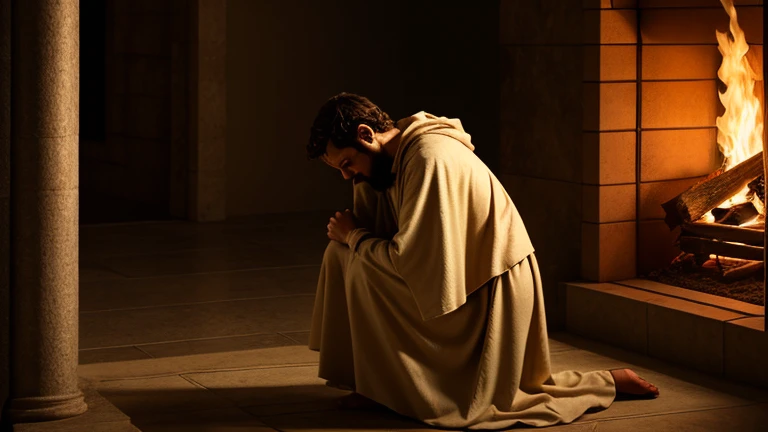
He took a steadying breath. “The second time, it was in the courtyard, while I warmed myself by the fire. A second servant girl pointed at me and said, ‘This man was with Jesus of Nazareth.’ The fear surged again. I looked around, at the soldiers and the others gathered, and I denied it again, even swearing on my life, ‘I don’t know the man!’ I wasn’t even thinking about what I was saying anymore. My mind was consumed with terror, with self-preservation.”
Peter closed his eyes for a moment, as if the memories were too painful to relive. “The third time came just as the rooster crowed. Someone in the crowd recognized me, ‘Surely you are one of them,’ they said. By then, I was desperate. My heart raced, my body trembled with fear. I swore I didn’t know Him. And at that very moment, the rooster crowed. And I remembered His words: ‘Before the rooster crows, you will disown me three times.’”
He paused, his voice raw as the weight of those words lingered. “In that instant, I realized what I had done. I had failed Him. I had denied the Lord who called me, who loved me. I wept bitterly that night, consumed by shame, regret, and guilt. I thought I had ruined everything.”
Peter’s gaze softened, reflecting on the grace that followed. “But that wasn’t the end of my story. It wasn’t the end for any of us. After He was crucified, I was lost. Jesus was gone, and I didn’t know what to do. I stayed in hiding, filled with shame, thinking I could never face Him again. But then, three days later, everything changed. Mary Magdalene came running to us, her voice filled with awe. She had seen Him, alive. At first, I didn’t believe it.
Peter’s voice grew softer as the memory unfolded. “John and I ran to the tomb together. I was slower than him, but when we arrived, he didn’t hesitate—he went in first. I followed him, and the sight was overwhelming. The linen cloths were there, but He was gone. It hit me then, in the silence of that empty tomb, that He had truly risen. He had done what He promised.”
He paused, reflecting further, his mind heavy with the truth of those moments. “But even then, I had a weight on my heart. I knew He was alive, but I wasn’t sure what that meant for me. What would He say to me? How could I face Him after what I had done? I had denied Him, betrayed Him in His darkest hour. I was ashamed, unworthy of His forgiveness. But even in that uncertainty, there was a spark of hope—a hope that, somehow, I could still be part of His story.”
Peter’s voice softened. “Though I didn’t understand it fully at the time, I knew He had triumphed over death. And though I had failed Him, He had not failed me. He was offering me something I didn’t deserve—grace. He had risen, and I was going to be part of His story, despite my failures. That day changed everything for me. It was the beginning of a new hope.”
He looked up, a small smile tugging at the corner of his mouth. “He appeared to us multiple times. But it wasn’t until that morning by the Sea of Galilee that my heart truly began to heal. We had been fishing all night, without catching anything. Then a man on the shore told us to cast the net on the right side of the boat. When the net filled with fish, I knew it was Him. I couldn’t wait; I threw myself into the water and swam to Him.”
Peter’s tone lifted as he finished, “It was there, in that moment of grace, that Jesus restored me. He didn’t condemn me for my failure. He forgave me, and He called me again, just as He had before. He said, ‘Feed my sheep.’ He didn’t revoke His calling on my life. And it’s that grace—His grace—that I stand before you with today.”
Peter smiled faintly, his eyes glistening with emotion. “After breakfast, He turned to me and asked, ‘Simon, son of John, do you love Me more than these?’ He asked me three times, the same number of times I had denied Him. Each time I said, ‘Yes, Lord, You know that I love You,’ He gave me a command: ‘Feed My lambs.’ ‘Take care of My sheep.’ ‘Feed My sheep.’ He wasn’t just forgiving me; He was restoring me, entrusting me with the care of His people. His grace was greater than my failure.”
The room was silent, save for the occasional rustle as someone wiped away a tear. Peter let the moment linger before speaking again.
“I see in this church the same hunger and hope I saw in the early days of the faith. But I also see distractions—an overemphasis on performance, divisions over trivial matters, and a tendency to focus inward rather than outward. The church is not a building, nor is it a platform for the few. It’s a community, a body bound together by love and the mission to make disciples of all nations. Don’t lose sight of that. Don’t let the comforts of this world dull your urgency to spread the gospel.”
Peter’s voice grew firm, his passion evident. “You may fail, as I did. You may stumble and feel unworthy. But let me tell you this: Jesus does not call the perfect; He perfects the called. Your failures are not the end. His grace is sufficient, and His love knows no bounds. He will restore you if you let Him.”
Peter’s expression grew solemn as he spoke of his final days. “After Jesus ascended, I spent the rest of my life telling others about Him. It wasn’t easy—many times, it came at great cost. But I never hesitated, because I knew the truth of what I had witnessed, and there was nothing more important than sharing that with the world.
When the time came for my own death, I was arrested and condemned. I was to be crucified, but I begged them not to crucify me in the same way they had crucified my Lord. I felt I wasn’t worthy of that. The tradition says they hung me upside down, and I accepted it as my fate. Whether the details of how I died are exactly as the stories say, I can’t be certain. But I know this: there’s no greater honor than to lay down your life for Christ. And in the end, that’s what I did. I gave everything for Him, just as He had given everything for me.”
As he closed, Peter offered a prayer, his words simple but powerful. “Lord, remind us of Your grace when we fall, Your strength when we are weak, and Your call when we are distracted. May Your church remain a beacon of hope in a world that so desperately needs You.”

Disclaimer:
The views and opinions expressed in this post are solely those of the author. The information provided is based on personal research, experience, and understanding of the subject matter at the time of writing. Readers should consult relevant experts or authorities for specific guidance related to their unique situations.
Wonderful!