
1,629 words, 9 minutes read time.
I was born in Bethsaida, a small village along the Sea of Galilee. I can still hear the lapping of the water against the shore, the laughter of children playing in the distance, and the familiar sounds of the fishermen pulling their nets to shore. There was a time when I took it all in—when my world was filled with color, movement, and light. My father was a fisherman, and my mother, though soft-spoken and gentle, was the heartbeat of our home. They worked hard, as many did in Bethsaida, and I often helped them when I could.
But those days—those precious, carefree days—ended when the darkness came.
It was subtle at first, like the fading of a sunset. I would squint my eyes to look at something in the distance, but it never seemed to come into focus. My vision blurred more each day, until it became impossible to make out even the faces of those closest to me. I remember my mother’s warm embrace, the sound of her voice, but it was as if everything was veiled behind a thick fog, a mist that would not lift.
When I was just a child, the darkness overtook me entirely, and I became blind.
In our village, a blind man was not merely a person who couldn’t see—he was someone who was often seen as cursed or outcast. Many people, when they saw my blind eyes, would turn away, not wanting to look at the evidence of sin or misfortune. It was a harsh truth, but it was the way of the world at that time. There were those who whispered that my blindness was a punishment—either for my own sins or the sins of my ancestors. It was an accusation I could never escape.
At first, my parents tried to comfort me, encouraging me to adapt. They helped me learn to navigate the world through sound and touch. I became intimately familiar with the voices of our village, the texture of the walls of our home, and the smoothness of the stone paths. But the absence of sight left an emptiness in me. I longed to see. I wanted to watch the sunsets again, to admire the vibrant colors of the sky as the sun dipped below the horizon, but all I could do was listen to the faint murmurs of the world around me.
Still, life went on. My parents did their best to care for me, but as the years passed, I felt the burden of my blindness grow heavier. I was a grown man now, no longer a child, and I could sense the exhaustion in my mother’s voice, the strain in my father’s hands. They loved me, but they were weary. The weight of my blindness was more than they could bear alone, and the village had little to offer me in terms of help.
Then, one day, I overheard something that would change my life forever.
The murmurs were quiet at first, but they grew louder. A man named Jesus of Nazareth was said to heal the sick, cast out demons, and perform miracles. He healed the lame, made the mute speak, and, most remarkably to me—he made the blind see. I had heard such stories before, but there was something different in the way these stories were told. This man wasn’t like the others. He wasn’t a magician or a trickster. No, he was a healer—a true healer—and his power was said to come from God.
At first, I was skeptical. How could a man—any man—heal me? How could I, a blind beggar in Bethsaida, find the mercy of such a miracle? But the thought of seeing again, of living in a world of color and clarity, stirred something deep within me—something I hadn’t felt in years: hope.
It was just a rumor, nothing more than whispers on the wind, but it was enough to plant a seed in my heart. I needed to know more. I began to listen closely to every conversation, every word spoken about this Jesus. Could it be true? Could this man actually heal me?
One morning, my mother told me that Jesus was coming to our village. She had heard from one of the merchants passing through that he would be in Bethsaida soon, and the excitement in her voice was palpable. For a moment, I dared to believe that I could be healed. My heart raced with anticipation, but there was something else—something I couldn’t quite name. Fear. I was afraid of the possibility of hope, afraid of being disappointed again, afraid of the letdown if nothing changed. But in the end, I had nothing left but the desire to see.
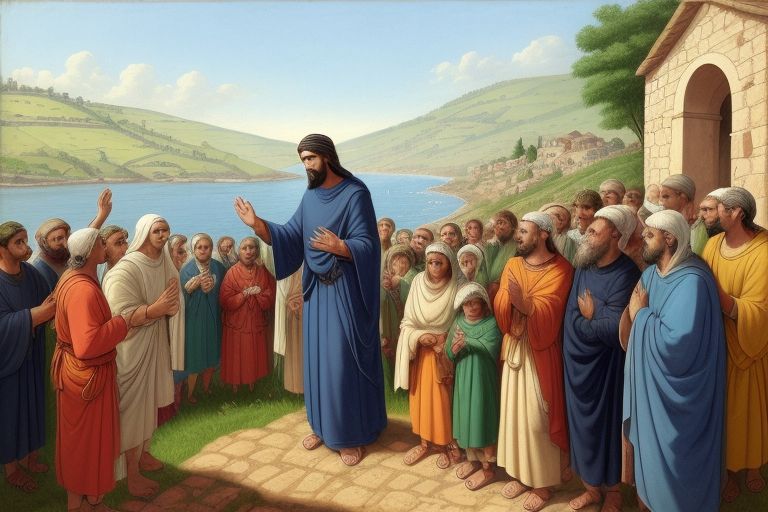
The day came. The air was thick with excitement, and I could feel the presence of the crowd growing larger as we neared the place where Jesus would be. My family guided me through the mass of people, their hands holding mine, steadying me as we made our way to the front. I could hear the murmurs, the excitement. People were talking about miracles, about healings, about things that seemed impossible.
Then, I felt it—a calmness, a quiet that settled over the crowd. A sense of peace filled the air. I knew, somehow, that Jesus was near.
When I stood before him, I didn’t know what to say. How do you ask a man for something so impossible? How do you ask for the restoration of a life you thought was gone forever? But I did ask, for I had nothing left but the hope that he could change my life. “Lord,” I said, “I want to see.”
He didn’t answer at first. He simply took my hand, and I felt him guiding me away from the crowd, away from the familiar sounds and voices of my village. We walked in silence, and I could feel a strange mix of peace and anticipation washing over me. Where were we going? Why was he leading me away from everyone?
I could hear the soft rustle of leaves and the faint sound of water in the distance as we came to a stop. And then, Jesus touched my eyes. I felt the coolness of his hand, the gentleness of his touch. But then something strange happened—he spat on the ground. I didn’t know why he did this, but I didn’t question it. His touch was enough for me.
With a quiet voice, he asked, “Can you see anything?”
I opened my eyes, desperate for something—anything. I squinted, hoping for a glimpse of light. But when I looked up, I was confused. Everything was blurry. Shadows moved, but they weren’t distinct. I saw men walking, but they looked like trees. They were figures in motion, but nothing was clear. “I see… but not clearly,” I said, my voice filled with confusion. “They look like trees, walking.”
Jesus didn’t seem surprised. He didn’t condemn me or scold me for my inability to see clearly. He simply touched my eyes again. This time, when I opened them, the world came into focus. It was as though a veil had been lifted, and the colors of the world flooded my vision. The sky was blue, the sea sparkling in the distance. I could see faces—the face of the man who had healed me, the faces of those who had brought me here, and even my own hands. I could see everything with clarity, and my heart swelled with joy.
“Lord,” I whispered, tears filling my eyes, “I can see.”
I had never known such joy. The darkness that had ruled my life for so long was gone. For the first time in years, I saw the faces of those I loved. I could look at the world with wonder once more. It was as though I had been reborn.
Jesus smiled gently, his eyes filled with compassion. “Go home, and do not return to the village,” he said.
At first, I didn’t understand. Why would he tell me not to return? But then it made sense. This miracle, this gift of sight, was not something for me to boast about in the streets. It was something sacred, something between Jesus and me. I was to carry this miracle in my heart, not as a story for others to gossip about, but as a testimony of faith.
I walked back to my family, my heart full of joy. I could see everything—the sun on the horizon, the green hills in the distance. The world was beautiful, more beautiful than I could have ever imagined. When I entered my home, I saw my mother’s face, the lines of age softened by her joy. She cried when she saw me, and I embraced her, grateful for this new life we would share together.
From that day forward, my life was no longer defined by blindness. I was no longer the man who lived in darkness, forgotten by the world. I was a man who had been healed by Jesus, a man who had been given the greatest gift—sight. But more than that, I had been given a second chance at life, at love, and at faith.
I have shared my story many times since that day. Some believe me, some do not, but it matters not. For I know the truth of what happened that day. I know the touch of Jesus, the healer who saw me, who healed me, and who gave me sight. And I will never forget the man who gave me more than I could have ever hoped for.
I am Eliazar, the blind man who now sees.
